
The good news? You can absolutely check backlinks without spending a dime. Whether you want to analyze your own website’s link profile or spy on competitors, multiple free methods exist to get the job done effectively. This comprehensive guide walks you through everything you need to know, especially when combined with the right tools for creating SEO-friendly content.
Table of Contents
- What Are Backlinks and Why Should You Care About Them?
- How Do I Check Backlinks in Google Using Free Methods?
- How to Analyze Your Backlink Data Effectively
- Proven Strategies to Build More Quality Backlinks
- Common Mistakes to Avoid When Building Backlinks
- How Often Should You Check Backlinks?
- Advanced Tips for Maximizing Free Backlink Tools
- Frequently Asked Questions
By the end of this article, you’ll understand exactly how to find, analyze, and leverage backlink data to transform your SEO strategy completely.
What Are Backlinks and Why Should You Care About Them?
Before diving into the methods for checking backlinks, let’s establish a solid foundation. Backlinks, sometimes called inbound links or incoming links, are hyperlinks from external websites that point directly to pages on your website.
Think of backlinks as recommendations. When a reputable website links to your content, they’re essentially telling their audience and search engines that your information holds value. Google’s algorithm has relied on backlinks as a core ranking signal since the very beginning, and despite numerous algorithm updates, links remain critically important today.
The Three Pillars of Backlink Value
Not all backlinks carry equal weight. Understanding what makes a backlink valuable helps you prioritize your efforts when analyzing your link profile:
- Authority and Trust: Links from established, reputable websites in your industry carry significantly more weight than links from unknown or spammy sources. A single backlink from a major publication often outweighs hundreds of low-quality links.
- Relevance: Google values contextual relationships. A backlink from a website covering similar topics signals stronger relevance than a random link from an unrelated niche.
- Link Placement: Editorial links placed naturally within content perform better than footer links, sidebar widgets, or comment spam. The position of your backlink matters tremendously.
How Backlinks Directly Impact Your Website
Understanding the practical benefits motivates consistent backlink monitoring:
- Higher Search Rankings: Websites with strong backlink profiles consistently outrank competitors with weaker link profiles for competitive keywords.
- Faster Indexing: Search engine crawlers discover new content by following links. More backlinks mean faster discovery and indexing of your pages.
- Referral Traffic: Quality backlinks drive actual visitors to your website. These referral visitors often convert better because they arrive with pre-established trust.
- Brand Authority: Being referenced by respected websites builds credibility and positions your brand as an industry authority.
- Competitive Intelligence: Analyzing competitor backlinks reveals link-building opportunities and successful content strategies.
How Do I Check Backlinks in Google Using Free Methods?
Now let’s explore the practical techniques for checking backlinks without opening your wallet. Each method offers unique advantages, and combining multiple approaches provides the most comprehensive picture of any website’s backlink profile.
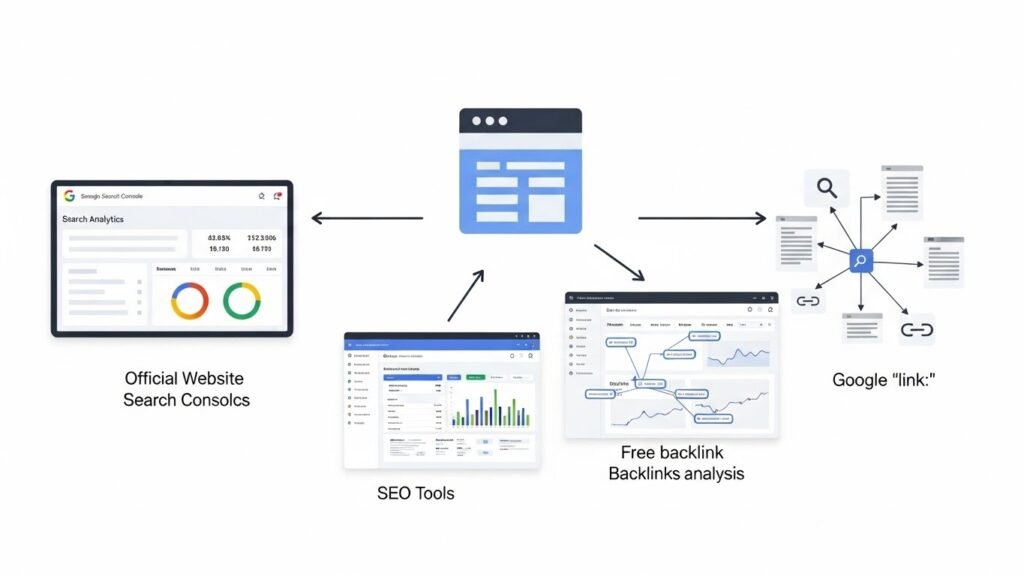
Method 1: Google Search Console – The Official Free Solution
Google Search Console stands as the most reliable free backlink checker tool for websites you own. Since the data comes directly from Google, you can trust its accuracy completely.
Step-by-Step Process to Check Backlinks in Google Search Console
- Access Your Account: Navigate to Google Search Console and sign in with your Google account.
- Add Your Property: If you haven’t already, add your website as a property. You’ll need to verify ownership through DNS records, HTML file upload, or other verification methods.
- Navigate to Links Section: Once verified, click “Links” in the left-hand navigation menu. This section contains all your backlink data.
- Analyze External Links: The “External links” section displays your total backlink count, top linked pages, top linking sites, and top linking text (anchor text).
- Export Your Data: Click “Export external links” to download a complete spreadsheet of your backlinks for detailed analysis.
Google Search Console provides insights you won’t find anywhere else, including which specific pages attract the most links and which anchor text variations other websites use. Learn more about maximizing this tool at the official Google Search Console Help Center.
What Google Search Console Shows You
- Total number of external links pointing to your site
- Top linked pages on your website
- Top linking domains sending backlinks
- Most common anchor text used in backlinks
- Internal linking structure overview
Method 2: Ahrefs Free Backlink Checker
Ahrefs offers one of the most generous free backlink checker tools available. Without creating an account, you can check backlinks for any domain and see the top 100 backlinks along with key metrics.
How to Use the Ahrefs Free Tool
- Visit the Ahrefs free backlink checker webpage
- Enter any domain or specific URL you want to analyze
- Click “Check backlinks” to generate your report
- Review the top 100 backlinks, referring domains, and domain rating
The free version provides domain rating (DR), the number of backlinks, referring domains, and a sample of actual linking pages. This works wonderfully for quick competitor analysis or initial research.
Method 3: Ubersuggest Backlink Analysis
Neil Patel’s Ubersuggest platform includes a surprisingly robust free backlink checker tool. The free tier allows limited daily searches but provides valuable data including:
- Domain score and overall health assessment
- Total backlinks and referring domains
- New and lost backlinks over time
- Anchor text distribution analysis
- Follow vs. nofollow link breakdown
Ubersuggest excels at visualizing backlink trends, helping you understand whether your link profile grows or shrinks over time.
Method 4: SEMrush Free Backlink Analytics
SEMrush provides free backlink checks with limited daily queries. The tool reveals:
- Authority score for linking domains
- Types of backlinks (text, image, form)
- Geographic distribution of linking sites
- Top anchors and referring domains
Creating a free account expands your daily limit and unlocks additional features for checking backlinks more thoroughly.
Method 5: Moz Link Explorer Free Version
Moz’s free backlink checker tool offers 10 free link queries monthly. Each query provides:
- Domain authority (DA) and page authority (PA) scores
- Spam score assessment
- Root domains linking to your site
- Top pages by link equity
- Discovered and lost links
Moz pioneered the domain authority metric, making their tool particularly useful for evaluating link quality alongside quantity.
Method 6: SmallSEOTools Backlink Checker
For unlimited quick checks, SmallSEOTools offers a completely free backlink checker without registration requirements. Simply enter any URL and receive instant results showing:
- Total backlinks detected
- Unique referring domains
- Dofollow and nofollow link counts
- Linking page URLs and anchor text
While less comprehensive than premium alternatives, this tool works perfectly for rapid research and initial exploration.
Method 7: Using Google Search Operators
Although limited in scope, Google search operators can reveal some backlinks pointing to your website. Try these search techniques:
link:yourdomain.com– Shows some pages linking to your site (deprecated but occasionally useful)"yourdomain.com" -site:yourdomain.com– Finds mentions of your domain on other websitesinurl:yourdomain.com -site:yourdomain.com– Discovers URLs containing your domain name
These methods won’t capture all backlinks, but they can uncover links that automated tools sometimes miss and require using proper SEO analysis methods for complete insight.
How to Analyze Your Backlink Data Effectively
Gathering backlink data represents only half the battle. Transforming raw numbers into actionable insights requires systematic analysis. Here’s how to evaluate your backlink profile like a professional SEO specialist.
Evaluating Backlink Quality
Focus on these key indicators when assessing individual backlinks:
- Domain Authority/Rating: Higher authority linking domains pass more value. Prioritize backlinks from sites with DA/DR above 30.
- Relevance: Does the linking site cover topics related to your content? Relevant backlinks carry more weight.
- Traffic: Linking sites with actual visitors provide both SEO value and referral traffic potential.
- Link Placement: Editorial links within content outperform sidebar or footer links.
- Anchor Text: Natural anchor text variation signals organic link building. Over-optimized anchors raise red flags.
Identifying Toxic Backlinks
Not all backlinks help your website. Some can actually harm your rankings. Watch for these warning signs:
- Links from websites with extremely high spam scores
- Links from completely irrelevant or foreign language sites
- Links from known link farms or private blog networks (PBNs)
- Hundreds of links from the same domain
- Links from adult, gambling, or pharmaceutical sites (unless relevant)
- Links with exact-match anchor text in suspicious quantities
If you discover toxic backlinks, use Google’s disavow tool to tell search engines you don’t want these links counted. However, use disavow cautiously and only when you’re confident links are genuinely harmful.
Benchmarking Against Competitors
Understanding your backlink profile in isolation provides limited insight. Compare your metrics against top-ranking competitors to establish realistic goals and identify opportunities.
For competitive analysis:
- Identify your top 5 competitors ranking for target keywords
- Check backlinks for each competitor using free tools
- Compare total backlinks, referring domains, and domain authority
- Identify linking sites that link to competitors but not to you
- Analyze competitor anchor text profiles for patterns
This analysis reveals the backlink gap you need to close and specific websites worth pursuing for links, while tracking SEO performance correctly becomes essential for making informed decisions.
Proven Strategies to Build More Quality Backlinks
Now that you know how to check backlinks in Google and analyze them properly, let’s explore strategies for acquiring new high-quality links.
1. Create Link-Worthy Content
The most sustainable backlink strategy involves creating content so valuable that other websites naturally want to reference it. Content types that consistently attract links include:
- Original Research: Surveys, studies, and data analysis that provide unique insights
- Comprehensive Guides: In-depth resources covering topics exhaustively
- Infographics: Visual content that simplifies complex information
- Tools and Calculators: Free utilities that solve problems for your audience
- Expert Roundups: Collections of insights from industry authorities
2. Strategic Guest Posting
Writing articles for established websites in your niche builds backlinks while expanding your audience reach. Follow these best practices:
- Target websites with genuine audiences and strong domain authority
- Pitch unique topics that haven’t been covered on the target site
- Create exceptional content that rivals the host site’s best articles
- Include natural, contextual links back to your relevant content
- Build relationships with editors for ongoing opportunities
3. Broken Link Building
This technique involves finding broken links on other websites and suggesting your content as a replacement. The process works as follows:
- Find resource pages in your niche with outbound links
- Use free tools like Check My Links (Chrome extension) to identify broken links
- Create content that matches what the broken link originally referenced
- Contact the website owner, inform them about the broken link, and suggest your content
This approach provides genuine value to website owners while earning you quality backlinks.
4. Unlinked Brand Mentions
Sometimes websites mention your brand without linking. Finding and converting these mentions into backlinks offers quick wins:
- Set up Google Alerts for your brand name and key product terms
- Use free backlink tools to find mentions without links
- Reach out politely to ask if they’d consider adding a link
Since these sites already know your brand, conversion rates for these requests tend to be high.
5. Resource Page Link Building
Many websites maintain resource pages linking to helpful content in their niche. To earn these links:
- Search for resource pages using queries like “[your topic] + resources” or “[your topic] + useful links”
- Identify pages that would benefit from including your content
- Send personalized outreach explaining why your resource deserves inclusion
6. HARO (Help A Reporter Out)
Journalists and bloggers frequently seek expert sources for their articles. HARO connects you with these opportunities:
- Sign up for free at HARO
- Receive daily emails with source requests in your expertise areas
- Respond quickly with valuable, relevant insights
- Earn backlinks when your quotes get published in articles
This strategy can generate high-authority backlinks from major publications when executed consistently.
Common Mistakes to Avoid When Building Backlinks
While building backlinks, avoid these pitfalls that can damage your SEO efforts or even result in penalties:
Buying Backlinks
Purchasing links violates Google’s guidelines and puts your website at serious risk. Paid link schemes often involve low-quality sites and can trigger manual penalties that devastate rankings.
Participating in Link Exchanges
Excessive reciprocal linking (“I’ll link to you if you link to me”) raises red flags. While occasional natural reciprocal links are fine, patterns of exchanged links appear manipulative.
Over-Optimizing Anchor Text
Natural backlink profiles contain diverse anchor text including brand names, naked URLs, generic phrases, and partial match keywords. If most of your backlinks use exact-match keyword anchors, Google may view this as manipulation.
Focusing Only on Quantity
Chasing high backlink counts without regard for quality wastes time and can harm your site. Ten links from authoritative, relevant websites outperform thousands of spammy links.
Ignoring Nofollow Links
While dofollow links pass more direct SEO value, nofollow links still provide benefits. They drive traffic, build brand awareness, and create a natural-looking link profile. Don’t dismiss nofollow opportunities entirely.
How Often Should You Check Backlinks?
Establishing a regular backlink monitoring schedule ensures you catch opportunities and problems early. Here’s a recommended frequency based on website size and goals:
- Small Websites/Blogs: Monthly backlink audits provide sufficient oversight
- Growing Businesses: Bi-weekly checks help track active link-building campaigns
- Large Websites: Weekly monitoring catches issues quickly and tracks numerous incoming links
- After Major Campaigns: Check backlinks immediately after content launches or outreach pushes
Consistency matters more than frequency. Choose a schedule you can maintain and stick with it.
Advanced Tips for Maximizing Free Backlink Tools
Extract maximum value from free backlink checker tools with these professional techniques:
Combine Multiple Data Sources
No single tool captures every backlink. Using 3-4 different free backlink checker tools and consolidating the data provides a more complete picture than relying on one source alone.
Create a Tracking Spreadsheet
Export backlink data to spreadsheets and track metrics over time. Document:
- Total backlinks and referring domains monthly
- New backlinks acquired and sources
- Lost backlinks and potential reasons
- Domain authority trends
- Competitor comparisons
Set Up Alerts
Configure Google Alerts for your brand name, key executives, and product names. This helps you discover new mentions that could become backlink opportunities.
Focus on Referring Domains
While total backlink count gets attention, referring domains matter more. One hundred backlinks from 100 different websites typically outperform 1,000 backlinks from 10 websites.
Frequently Asked Questions
What is the most accurate way to check backlinks in Google?
Google Search Console provides the most accurate backlink data for websites you own because the information comes directly from Google’s index. For checking competitor backlinks or sites you don’t own, combining data from multiple free backlink checker tools like Ahrefs, Moz, and SEMrush gives the most complete picture.
How long does it take for new backlinks to impact rankings?
New backlinks typically take 2-12 weeks to influence rankings, depending on how frequently Google crawls the linking page and your website. High-authority links from frequently crawled sites may show impact faster than links from smaller websites.
Can I check backlinks without any tools?
You can use Google search operators like "yourdomain.com" -site:yourdomain.com to find some pages mentioning or linking to your site. However, this method captures only a fraction of actual backlinks and shouldn’t replace proper backlink checker tools.
Do social media links count as backlinks?
Most social media links carry “nofollow” attributes, meaning they don’t pass direct SEO value. However, social links drive traffic, increase content visibility, and can lead to natural backlinks when people discover and share your content.
How many backlinks do I need to rank on Google?
There’s no universal number because requirements vary by keyword competitiveness, industry, and content quality. Focus on analyzing top-ranking competitors for your target keywords and working toward similar backlink profiles rather than arbitrary numbers.
Is it possible to rank without backlinks?
Ranking for low-competition, long-tail keywords is possible without backlinks, but competitive terms almost always require strong backlink profiles. Backlinks remain one of Google’s top ranking factors and shouldn’t be ignored in any serious SEO strategy.
What’s the difference between a backlink and a referring domain?
A backlink represents a single link from one page to another. A referring domain represents a unique website that links to you. If one website links to you 50 times, that counts as 50 backlinks but only 1 referring domain.
Should I disavow backlinks I didn’t build?
Only disavow backlinks if you’re confident they’re harmful and may be causing ranking issues. Google’s algorithm generally ignores low-quality links without manual intervention. Unnecessary disavowing can actually harm your SEO by removing valuable links you underestimated.